
How to Set Up an AI Department for Your Practice
Treat AI as a department, not a purchase. The simple three-function framework I used with a four-doctor practice to run AI well.
If you're like me, you've read the AI news and wondered: How does this apply to me?
Sure, big companies have money to spend. Health systems are deploying Ambient Scribes. Insurers are using AI for claim reviews. Others are building large independent AI departments.
But could a smaller business or medical practice do the same?
You absolutely can.
And you should.
But before you go online and flirt with AI agents promising to solve all your problems, I'll save you heartache with the same framework I helped a 4-doctor practice use.
To get the most out of these tools, create your own "AI Department." Define it as having three distinct functions: Selection, Oversight, and Enablement.
Get these three things right, and you'll avoid some costly mistakes.
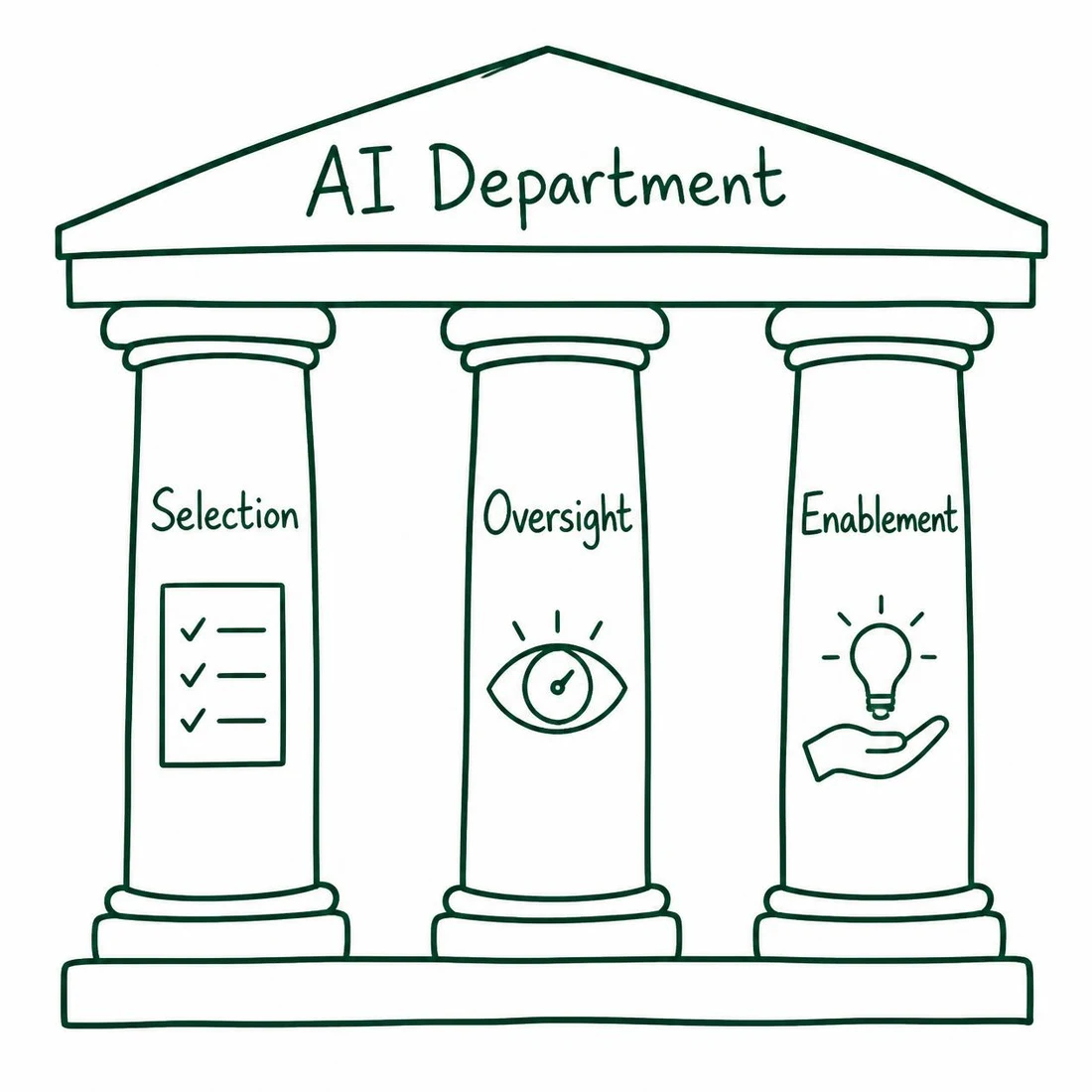
Selection
To start, you need to drive the AI, not the other way around. This applies to the companies reaching out to you now, promising that AI will cure everything if you just let them in. Otherwise, you can end up with a messy implementation and doubt what you were hoping for.
Choosing the right AI solution starts with a clear vision of what you want to change.
And make sure you name it.
No-show rate, cancellation rate, call-offs, missed phone calls, denial rates, appeal rates, underpayments, revenue cycle time, number of coffees you drink a day.
Choose something that matters to your practice and prioritize it. Broadly speaking, all AI solutions generate returns in two categories:
Financial ROI and capacity created.
Both matter, but make sure any solution returns more cash than you spend. You'll be surprised at how many estimate incredible returns only to realize they were calculated by multiplying hours saved by dollars, not actual cash created.
For example, Ambient AI is mostly a capacity creator. Financial returns can be difficult to calculate, and more often than not doctors have already found ways to document faster. So the AI Department might find this to be a weak candidate. AI revenue cycle management, on the other hand, would have a much clearer line on recapturing denials and lost revenue.
Also, a quick note: I like my AI startups like Goldilocks likes her soup. Not too small, where they are unproven. Not too large, where the solutions are too nonspecific. I like them right in the middle, where they offer great customer service and a great solution.
Oversight
AI by definition is continuously evolving and learning. A successful AI department will do two things: monitor internal performance and the external landscape. This could be done monthly.
Internally, review the metrics chosen during selection to ensure the solutions in place and the teams using these systems are evolving. Give feedback to both so they improve over time. You'll likely run into a few unplanned edge cases at the start.
Externally, monitor the regulations and requirements needed to keep a successful AI implementation going. These would include new disclosures you might need to put in place. I've seen this done as a bi-weekly podcast that was 100% AI-generated. It was accurate and insightful.
Also, your AI Department should watch for when pricing for AI models drops and when it might be a good chance to renegotiate AI fees!
Enablement
Think of this as AI literacy for your teams. AI unlocks efficiency and creativity.
Your successful AI department would spend time ensuring their teams understand how to use AI. Then let them bring those ideas to you!
Imagine your privacy manager can whip up audits that are up to date with your requirements and even ping other team members to complete their parts too. Or an administrative assistant that easily creates videos, podcasts, or educational materials for patients tailored to their needs in minutes.
All these ideas would typically be too niche for an AI startup to create. But created internally, you'd have more ideas than you'd know what to do with. Your AI Department would play a critical role in fostering this culture of experimentation.
Compliance is another important topic. The department can train on the safe use of PHI with AI and other important guardrails, all of which can be done with your privacy manager.
Your AI department could be you, or a talented team member looking to grow, or partnered across multiple practices. The important thing is taking the steps in the right direction.
And if you need help figuring out any of these three pillars, contact me in the link below.